I was poking round on the Monterey Jazz Festival website the other day and found this video of an interview the artist in residence, Ambrose Akinmusire:
I think artists seem to understand the importance of sequencing and considering the entire package when designing something. In my research I hope to learn from the artists and show that this can be applied to service design. With any luck, I can meet Ambrose and talk with him more about these ideas...
February 24, 2012
Reading the table
Wall Street Journal reported recently on some strategies about how a waiter might "read" a table, i.e., learn from the mannerisms of the customers about how best to serve them. I found the interactive picture pretty revealing:

I think this is a good example of how a service process can be very different from a manufacturing process. In a traditional manufacturing process you have to train a person to do the same thing all day every day: put the bolt into the hole over and over again on the assembly line. In a service, the production worker must be able to react to the changes in the process, most notably the differences of customers. Treating all customers the same way may lead to the wrong experience for some customers. Customers must be treated individually.
Here's a good sesame street clip that shows what might happen if the wrong message is given to the wrong customer:

I think this is a good example of how a service process can be very different from a manufacturing process. In a traditional manufacturing process you have to train a person to do the same thing all day every day: put the bolt into the hole over and over again on the assembly line. In a service, the production worker must be able to react to the changes in the process, most notably the differences of customers. Treating all customers the same way may lead to the wrong experience for some customers. Customers must be treated individually.
Here's a good sesame street clip that shows what might happen if the wrong message is given to the wrong customer:
April 1, 2011
Backstage design: LDS general conference edition
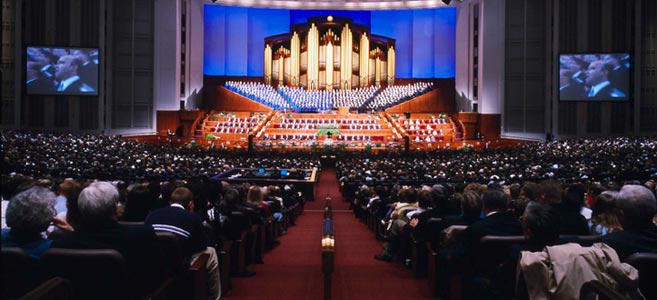
The LDS Church (of which I am a member) is hosting its semi-annual world wide General Conference this weekend. The conference is broadcast from Salt Lake City, UT to 13 million members of the church around the globe. The conference mostly includes talks given by the leaders of the church given in the Conference Center, a building designed and built primarily for this one purpose:
With 21,200 seats, the Conference Center is considered to be the largest theater auditorium in the world; the next nearest holds only about half as many people. But the months of careful planning and preparation create an unmistakable atmosphere of a house of worship as more than 100,000 Saints gather in the Conference Center twice a year to hear the counsel of living prophets and sing the hymns of Zion.Last week the Church released a news brief describing some of details that take place in preparation of the conference:
An extraordinary amount of work requiring the coordination of many Church departments and hundreds of people around the world goes into preparing for general conference. The five sessions of conference draw a total of about 100,000 people to the Conference Center every six months and are broadcast to millions more around the world.
The article provides some details about the building of the rostrum, the floral arrangements, the camera, sound, lighting, satellite broadcasting, translation, teleprompting and others aspects that happen behind the scenes to make the conference successful. But success from the perspective of the "behind-the-scene" design is defined in an interesting way:
“Our goal is to be totally transparent,” said Russ Crabb, a producer for general conference. “We want to come away from conference with a message that’s clean and clear to everyone who’s listening or watching, and we want to support the First Presidency and Church leaders at a level that does that.”
“I think the overall level of preparation lends itself to the importance of conference,” said Thomas Smith, safety manager for the Church Media Services Department. “There is planning so this experience is not one that detracts from the spirit of conference. . . . We’re trying to make it something that will touch people’s hearts and bring them to Christ.”The idea of transparency of service design is not a new one, it's what makes the backstage preparation difficult; if transparency in the preparation fails the delivery of the core service is compromised or at least sub-optimal.
Check out the videos on the link about the preparation that goes in to producing a weekend of spiritual enrichment.
March 16, 2011
Sound as an element in experience design
Another quick post since I am spending most of my time writing my dissertation. I thought this was a good example of using sound as an element of service design.
Making the queue part of the experience: Disney Edition
I'm in the thick of dissertation mode, but I found this video interesting and wanted to post it just to be able to record it.
March 2, 2011
Dinner and a Movie - Mash-ups
Service Encounter Onstage recently blogged about the benefits of combining two experiences into one - a dinner AND a movie. AMC calls is "Fork and Screen".

I think the premise is solid; however, I think it is folly to think that since I do movies well, I can easily do food well or vice versa. Certainly the nature of the experience is different, the first being the tangibility of the food vs the intangibility of the movie - if the food is no good the blame falls on the theater, if the show is no good the blame will fall on the movie producer. Ordering and eating food is an active customer action while watching a movie is passive. I wonder if combining these two disparate forms of experience is a good idea from a management stand point; at the very least it would raise a lot of questions about how quality and experience theme be maintained, how are customer expectations managed, how do HR policies change etc?
Something like this came up in class the other day as a joke. We were discussion the intangibility of services and compared a massage to an auto repair shop. Massages are very intangible because you leave with only a feeling of relaxation, but no physical product. I always thought that an auto repair was pretty tangible because you do get a car back when you are finished, but a student pointed out that because it is difficult for customers to know if the car is actually fixed or if it needed what was said to be fixed, it was very intangible and customers leave feeling stressed. So we came up with a recommendation of a massage at the auto repair shop to relive stress of the unknown.
All this talk of combining things reminded me of a term "Mash-up" made popular by the television show Glee. the idea of a mashup is to combine elements of two songs to create a new better song - maybe the melody of one song with the lyrics a rhythm of another In their words:
Here's a clip of some Glee mash-up action. Enjoy!

I think the premise is solid; however, I think it is folly to think that since I do movies well, I can easily do food well or vice versa. Certainly the nature of the experience is different, the first being the tangibility of the food vs the intangibility of the movie - if the food is no good the blame falls on the theater, if the show is no good the blame will fall on the movie producer. Ordering and eating food is an active customer action while watching a movie is passive. I wonder if combining these two disparate forms of experience is a good idea from a management stand point; at the very least it would raise a lot of questions about how quality and experience theme be maintained, how are customer expectations managed, how do HR policies change etc?
Something like this came up in class the other day as a joke. We were discussion the intangibility of services and compared a massage to an auto repair shop. Massages are very intangible because you leave with only a feeling of relaxation, but no physical product. I always thought that an auto repair was pretty tangible because you do get a car back when you are finished, but a student pointed out that because it is difficult for customers to know if the car is actually fixed or if it needed what was said to be fixed, it was very intangible and customers leave feeling stressed. So we came up with a recommendation of a massage at the auto repair shop to relive stress of the unknown.
All this talk of combining things reminded me of a term "Mash-up" made popular by the television show Glee. the idea of a mashup is to combine elements of two songs to create a new better song - maybe the melody of one song with the lyrics a rhythm of another In their words:
"A 'Mash-up' is when you take two songs and you mash them together to create an even richer Explosion of Musical Expression."It seems to work best if the two songs have something in common enough for the audience to pickup on the clever combination of the themes of the two songs. Perhaps similiar advice might apply when considering combining two experiences. Maybe a dinner and a movie might fit better together than a massage and an auto repair?
Here's a clip of some Glee mash-up action. Enjoy!
March 1, 2011
Analytics of a Service
The good news is that I have recently accepted a faculty position at the Naval Postgraduate School in Monterey California! I will likely be teaching business statistics, so in preparation I have started an additional blog to record some idea to share with my future student along the line of business statistics. In the meantime, I'll keep posting here too. In honor of this new blog, I found a great clip from IBM touting the use of analytics in a healthcare setting:
We had a great discussion in my operations management MBA class yesterday about what I identify as 2 main frameworks that can be applied to practical service operations management. I call them analytical and behavioral. Under analytical we discussed queuing, revenue management, optimization, simulation, data modeling, etc, while under the behavioral framework we have to understand motivation, experiences, emotions, needs, etc. Because customers are often in the service process, ignoring the behavioral aspect can be detrimental. Additionally, behavioral aspects of a service cannot be delegated to the marketing department alone, instead the discussion of the experience desired for customers has to be a part of the operations management priorities or it won't be executed. This clip discusses how a hospital in Toronto has been able to record and analyze data from a new born from the instruments that surround it. The difficulty in the behavioral side of service operations management is that measurement is hard and near impossible in real time. While it is fairly easy to count how many people are in a line at a give time, it is not easy to tell who is upset about it and who is not.
We had a great discussion in my operations management MBA class yesterday about what I identify as 2 main frameworks that can be applied to practical service operations management. I call them analytical and behavioral. Under analytical we discussed queuing, revenue management, optimization, simulation, data modeling, etc, while under the behavioral framework we have to understand motivation, experiences, emotions, needs, etc. Because customers are often in the service process, ignoring the behavioral aspect can be detrimental. Additionally, behavioral aspects of a service cannot be delegated to the marketing department alone, instead the discussion of the experience desired for customers has to be a part of the operations management priorities or it won't be executed. This clip discusses how a hospital in Toronto has been able to record and analyze data from a new born from the instruments that surround it. The difficulty in the behavioral side of service operations management is that measurement is hard and near impossible in real time. While it is fairly easy to count how many people are in a line at a give time, it is not easy to tell who is upset about it and who is not.
Subscribe to:
Posts (Atom)