Showing posts with label Service Design. Show all posts

October 1, 2015

Self-service choice: paralysis or freedom


The Canadian newspaper The Globe and Mail reported today about a new self-service kiosk that McDonald' of Canada is rolling out that purportedly is targeted towards higher-end customers who want a customized burger.  The idea is that a customer can make their own burger and each additional topping will add to the cost.    They report

The efforts are bound to stir a buzz but the added touches also come with a price. Mr. Betts digitally ordered a $9.26 Angus True Blue & Guac (blue cheese and guacamole) burger with fries and iced coffee (with an extra espresso shot) for a total of $12.46. The custom burger prices at the kiosks are more than 15 per cent higher than those of a regular Big Mac. A burger conceivably can cost as much as $50, depending on the extras.

I have a few thoughts about this idea:

1:  Added choice could lead to choice paralysis - research has shown that too many choices has led customers to balk.  While added choice leads to a sense of control - too much choice leads to out-of-control feeling.

 2: Perhaps choice paralysis not a big issue considering improved kiosk interfaces that lay out choices in a way that make them more "digestible"....

3.  The article quotes a researcher from University of Toronto that has done research to show that in self-service scenarios, customers are more likely to add more toppings.  They claim that potential embarrassment coming from the social-stigma that might come from a server's look when a customer says "give me one of everything" is not there in self-service concepts.  Customers are not afraid to order it all if they don't have to talk to a human to do it.

So, maybe the solution to choice overload is to put it on a nice user interface and let customers choose without the pressure of a human looking down at them.

Interesting stuff....,  leads me to a couple other thoughts:

4.  What if customers make a hamburger that they don't like?  What if they put everything on it and it is gross?  My son does this regularly.  He gets excited about a hamburger that we cook at home on the BBQ and proceeds to put everything in the fridge on the bun - last week he put potato salad on his burger.  he admitted that it was a mistake.  What happens if the product that a customer "customized" is a bad one?  Who gets the blame?  How do you recover from it?  How can you keep it from happening?  Can you put smart logic into the kiosk that tells that customers that the combination of topping might make them sick?

5.   My final issue with this idea is that fundamentally the operations and McDonald's doesn't likely have the capability of making a $50 hamburger.  They hire minimum wage workers to cook in a mini-factory.  They don't cook chefs who know how to prepare a $50 hamburger.


I like the idea of innovation in choice structure and thinking about how to avoid paralysis through technology is an interesting thought.
March 2, 2012

Operations Management Role in Service Design: Choreography

Chris Voss,  an operations management professor from the London Business School has published several articles indicating that the role of operations management in service design and delivery is one similar to a choreographer.  This video reminded me of that concept:


April 1, 2011

Backstage design: LDS general conference edition


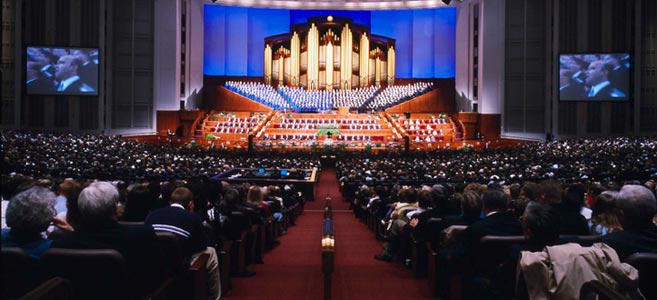
The LDS Church (of which I am a member) is hosting its semi-annual world wide General Conference this weekend.  The conference is broadcast from Salt Lake City, UT to 13 million members of the church around the globe.  The conference mostly includes talks given by the leaders of the church given in the Conference Center, a building designed and built primarily for this one purpose:

With 21,200 seats, the Conference Center is considered to be the largest theater auditorium in the world; the next nearest holds only about half as many people. But the months of careful planning and preparation create an unmistakable atmosphere of a house of worship as more than 100,000 Saints gather in the Conference Center twice a year to hear the counsel of living prophets and sing the hymns of Zion.
Last week the Church released a news brief describing some of details that take place in preparation of the conference:
An extraordinary amount of work requiring the coordination of many Church departments and hundreds of people around the world goes into preparing for general conference. The five sessions of conference draw a total of about 100,000 people to the Conference Center every six months and are broadcast to millions more around the world. 

The article provides some details about the building of the rostrum, the floral arrangements, the camera, sound, lighting, satellite broadcasting, translation, teleprompting and others aspects that happen behind the scenes to make the conference successful.  But success from the perspective of the "behind-the-scene" design is defined in an interesting way:
“Our goal is to be totally transparent,” said Russ Crabb, a producer for general conference. “We want to come away from conference with a message that’s clean and clear to everyone who’s listening or watching, and we want to support the First Presidency and Church leaders at a level that does that.”
“I think the overall level of preparation lends itself to the importance of conference,” said Thomas Smith, safety manager for the Church Media Services Department. “There is planning so this experience is not one that detracts from the spirit of conference. . . . We’re trying to make it something that will touch people’s hearts and bring them to Christ.”
The idea of transparency of service design is not a new one, it's what makes the backstage preparation difficult;  if transparency in the preparation fails the delivery of the core service is compromised or at least sub-optimal.


Check out the videos on the link about the preparation that goes in to producing a weekend of spiritual enrichment. 


March 16, 2011

Sound as an element in experience design

Another quick post since I am spending most of my time writing my dissertation. I thought this was a good example of using sound as an element of service design.

February 14, 2011

Enchanted Art of Disney Cruise

I've blogged about this before here, but I like the idea so much I wanted to show it again - now it full production mode.  What I like most is that it is more than just a new monitor with an animation on it, if it ended there it would just be a TV with a motion sensor on it.  The exciting part is the interaction that can take place in the game.

November 12, 2010

More thoughts on operational capabilities vs. experience design

From marketing guru Seth Godin's blog post today:

It used to be that if you wanted to build an organization, you had to be prepared to do a lot of manufacturing and assembly--of something. ...

Restaurants used to be built by chefs. Now, more than ever, they're built by impresarios who know how to tie together real estate, promotion, service and chefs into a package that consumers want to buy. The difficult part isn't installing the stove, the difficult (and scarce) part is telling a story.

I'm talking about intentionally building a structure and a strategy and a position, not focusing your energy on the mechanics, because mechanics alone are insufficient. Just as you can't build a class A office building with nothing but a skilled carpenter, you can't build a business for the ages that merely puts widgets into boxes.
 Mr. Godin's thoughts are expressed in a different way, but I think the message is similar to a post I had yesterday.  Let's start to flush this idea out a bit more by creating a classic 2 by two matrix with experience design capabilities on one axis (low to high) and operational capabilities on the other.  Something like this:


So now what?   Well, I imagine the the high/high quadrant is a good place to be, but it implies high costs, but also high quality and value - think Disney. The low/low quadrant on the other hand is low service and low value, low costs - think vending machines.  It is interesting to think about the possibilities of the the other two quadrants.  For high operational capabilities, but low experience think traditional fast food with factory like precision, but very little emotional experience.   This quadrant has probably been well tread and is what most traditional operations management  people consider when thinking about improving a service.  Low operational capabilities but high experience design may lead to a service full of emotional stimulus, but with the risk of service failure lurking around since there is no operational backbone to support the experience. 

Still working through this idea and wondering if it is of any value when considering service strategy?  I think we could find examples of service firms trying to shift their offering into a different quadrant, for example McDonald's with a major redesign of store and Starbuck's pulling on the reins of their baristas operational efficiency .


I'm interested in hearing what you think about the idea.

November 11, 2010

Huge Restaurants: Trade off between Factory thinking and Experience thinking

Two recent articles in WSJ have pointed out some operations of mega restaurants - both are worth investigating.  The first is from the largest restaurant in the world in Damascus.  Here is the video:


After watching the video, operations management folks like myself get a bit excited to think about the shear planning and organizing it takes to produce and deliver so much food every night.  The kitchen essentially becomes an efficient factory and the head chef like a plant manager. 

The next article is about the Tao in Las Vegas, sorry no video, but here a couple of pictures and quotes:

Seconds count because Tao's kitchen serves 1,400 dinners on a typical Saturday night, making it one of the busiest high-end restaurants in the country. While partially cooking dishes in advance isn't unusual in restaurant kitchens, doing so with quick-cooking fish is. That's one way Tao is able to keep the plates moving fast enough to get its legions of diners fed

click to see full size

Although it is only open for dinner, Tao operates 24 hours a day, preparing Chinese, Japanese and Thai-influenced cuisine. On Saturdays, the busiest day, the restaurant employs 57 cooks, eight chefs, 26 servers and 10 hostesses. It goes through 1,400 pairs of chopsticks, 50 pounds of rice and three gallons of Heinz ketchup—a key component of its kung pao sauce. A four-person set-up team folds 1,800 napkins, stocks bars with lemon, lime and apple slices and prepares Tao's over-the-top (think 20-foot-tall Buddha statue) dining room for the night, including lighting 269 candles. One employee does nothing but sweep for his eight-hour shift.

"In Las Vegas, everybody is looking for the big experience," says Rich Wolf, co-owner of the Tao Group, which owns Tao Las Vegas, 11 other restaurants and seven nightclubs in New York and Las Vegas. "It isn't your first thought for a quiet, intimate date," but it's where "people can go to when they want to be festive and celebrate and paint the town red."
The restaurant is part of a 60,000-square-foot complex that also includes a lounge, the popular nightclub and Tao Beach, an outdoor club (closed in winter) with a dance floor, pool and cabanas that offer food, drink and massages. Tao's strategy is to keep people under its roof, and spending money, all night long. Dinner is treated like a pre-party for the wilder antics upstairs at the nightclub. On a recent evening, two barely-clad models hired by Tao frolicked in a rose-petal-filled bathtub near the dance floor.
 I suggest reading the entire article - it is fun to get a glimpse at how they do what they do.

I was struck, however, at the contrast between these two examples.  The first Damascus video was nearly entirely focused on the operational execution that needs to take place every night - chopping, prepping, ordering, inventory, etc.  The article about the Tao also spent considerable time on the topics of inventory, receiving, and food production, but on the other hand it emphasized the work that is put into creating experiences, for example:

By 10 a.m., the four set-up staff started preparing the dining room. One employee donned a harness and ropes to scale the 24-foot-high red wall and place rechargeable lights in the 48 candles highlighting the Buddha that rises above a pool filled with swimming Japanese carp. A representative from the Venetian hotel's floral department replaced the rose petals that filled the eight tubs dramatically lining the entrance to the restaurant.
I have no way of knowing if the Damsus restaurant does not spend similar resources on experience creation, but I think the contrast is interesting.  One one hand, the factory approach is essential to ensuring consitent quality and delivery of food and the food certainly influences the experience.  But, the experience must also consist of more than just the food and the Tao understands that well. 

It is interesting to think about what the right mix of factory/production thinking and experience design thinking is right for specific service and how much resources should companies place in each area.  I suppose it comes down to where the value is being created - is it the output of the kitchen (factory) or the atmosphere and experience of the dinning area.  How much weight do customers put on each aspect?   If a service designer is too biased toward one side or the other (factory vs experience thinking) what will happen? 

November 1, 2010

Transparency at the post office

Customer view - additional computer screen for customers to see what the server is doing on her screen.  As seen at Cornell Post Office - picture taken by permission.


I saw this computer screen at the post office a couple of weeks ago and thought it was interesting. It allows customers a view of what the server is doing on her computer screen. It is nothing more than a duplicate screen of what the server sees, but I thought it was a good example of process transparency. It also forces the process to be simple enough that a lay customer can understand what is going on. Additionally, it allows customers to check on what's going on - am I getting charged for something I didn't want - and begins the training of customers on a self service option.

In general, most would say that transparency is a good thing. But when I asked the postal workers what thy thought if it they grumbled a bit and said they were not impressed by it. They said it often didn't work and that they had to shut it down when they were logging in.  It sounds like it just added additional work for the servers.  Unsaid, but a bit implied was that it gave customers a bit too much of a feeling of control, that is, I assume customers might start questioning a bit what is going on, especially if servers hurry through screens.  So it might actually slow down the process if customers are able to see it.

So, is it the right thing to do?  Under what conditions does added transparency work?  Under what conditions might it harm things?

On a separate note, I was impressed by this offering:


This is a prepackaged, ready to send gift in the line at the post office.  Think about it, if you are waiting in line at the post office to send your cousins and nephews and nieces all their Christmas gifts and you still have one gift left to get and suddenly a reasonably priced Christmas classic dvd appears in front of you ready to ship - talk about impulse buy! 

September 24, 2010

Assorted Links

Robot waiters taking over:  here and here

Low fare, pay per use hotels:  here

Mass producing real hand painted art: here

Hotels using social media as quality assurance tool: here

Good example of a service "stage" Disney style: here  


September 3, 2010

Sequence in everything: campus tour edition

Hat tip Design for Service

A Cornell University Campus Tour


A new trend among universities is to use aspects of service and experience design in campus tour.  I suggest taking a look at this article for a good application of Pine and Gilmore's The Experience Economy in a University recruitment setting.  Here's an excerpt:
Jeff Kallay is a pioneer in this new frontier of college recruitment. Campus tours, he preaches, should not only relay information, but also create a memory. What makes a company (or college) great, he believes, isn’t just products or services: “It’s all about the experience.” To that end, he encourages colleges to tell stories that will distinguish them from competitors, to engineer an experience that will stick in consumers’ minds. Call it the Gospel According to Mickey.
There is a bunch about scripting and authenticity and creating peak moments:
 Gilbert suggests that colleges think about creating a “signature moment” during tours. Moreover, he urges them to consider ways of engaging the five senses (taste is usually the trickiest one). At the University of Akron, visitors gather around a forty-foot-tall statue by Dale Chihuly, a blue glass tower known as the “rock candy” sculpture. Later, guests receive a stick of blue rock candy, with a tag that thanks them for visiting and directs them to information about the artist and the university. (It’s the kind of marketing that might just crack your tooth.)
Apart from the idea of a peak moment, there is little discussion about how the sequence of a tour might influence the memory, i.e., where should the "signature moment" happen?  At the beginning, the end?  Where should we go first, then where, how should we end? Seems like these could be important.

Sequence in everything: T.V. plot and joke telling edition

I stumbled onto an interesting blog today from a T.V. writer Jane Espenson (hat tip Ransom Riggs). Here's what she says here blog is about:

I'm a former writer for Buffy the Vampire Slayer and have written episodes for shows including: Angel, Firefly, Gilmore Girls, Ellen, The O.C., Star Trek: Deep Space Nine, Dinosaurs, Andy Barker PI, Battlestar Galactica, Dollhouse, Caprica and others. My blog is intended to help new writers tackle the job of writing those all-important spec scripts. I can't read your work, get you an agent, or get you hired. But I can give you solid, time-tested script-writing advice!
I've been thinking a lot about how service design and experience design is a lot like story telling and even more like T.V. writing since we hope that the customers will continue to come back for more and more.  A good writer develops episodes that make the viewer want to come back next week to see whats next.

My favorite topic of sequence (see here and here for a review of why it is my favorite topic, maybe here too if you up to reading an academic article) is found dispersed in here blog and seems to be a pretty important topic to writing a good script.  Here are two posts I found interesting:

Sometimes the funniest part of a joke should not be put at the end: Not Lovin' It
I realize now... not to put the funniest word at the end of the line, but to make sure the line continued past it. This seemed to me to go against one of the basic principals of joke writing, but now I see the value in it. He wanted casual, easy, "thrown away" funny, not needy rim-shot comedy, begging for laughs by hitting every comedy-made-easy rule.
The pilot (first) show should be revealing: Hot Cold Openings
Yes. This is huge -- a lot of people never read past the opening, so making it as perfect as possible is crucial. Jeff says: I am a big believer that the opening line of a pilot (or the opening image, or the teaser) should be the series in microcosm.


August 11, 2010

Bike sharing service design


I just got back from a trip to Montreal were I was attending a management conference. We stayed at an apartment about 10 km from the conference so most days I took the metro, but on the last day I tried out the bike sharing system called bixi. I was impressed: it was easy, cheap, and fun.  Since I hang out with a bunch of operations management folks at the conference, we discussed how it must not be real easy to resuffle the bikes to make sure they are placed the were the demand is high at the right time - quite a operations research problem.

I read a related article today (here)  and thought the idea was worth noting.  The setup costs look lower, but the standardization of the bikes doesn't seem to exist which may mean higher ongoing cost (think Southwest Airlines has all the same type of place leads to lower fixing costs).  Also, I'm not sure about the suffling around of the bikes that happen in cities like Montreal that ensures a bike is where the demand is.  Still, an interesting service design:


The Social Bicycle System from Ryan Rzepecki on Vimeo.

July 16, 2010

Challenges in exporting services: Broadway Edition

I found an article in today's Wall Street Journal interesting.  It is primary about the challenges and success that face theater production when exporting a show to different parts of the country.

Exporting Broadway shows is a tricky proposition, however. It's not just a question of translating the dialogue and lyrics into the local language. There's also the thorny question of conveying humor and pop-culture references, and trying to gauge what audiences will respond to in vastly different cultures.
 During a light moment in Disney's "The Lion King," Zazu the bird is supposed to sing a cheerful but trite tune, prompting a groan of recognition from the audience. On Broadway, that song is "Supercalifragilisticexpialidocious." In Australia, it's the country's familiar "Tie Me Kangaroo Down, Sport." On a Shanghai stint, it was a ubiquitous Chinese ad jingle. In Germany, the bird sings the "Heidi" theme song, then yodels.

And a bit about "design for exporting":

Even at home, Broadway shows today are typically designed with a global audience in mind. About 1 in 5 theatergoers were international visitors in the 2008-09 season, the highest proportion on record, according to the most recent data available from the Broadway League. 

June 28, 2010

I want to go fast!!!

Is it about speed of just fun? Can you assume that better customer experience comes because your process is faster or can you just make your experience more enjoyable?  Maybe you could do both?

Singapore Airlines Sensory Branding

On my reading list is "Sensory Branding" by Martin Lindstrom.    From Farnam Street:

"Singapore airlines is the pinnacle of sensory branding and offers a full scale assault on our brains. Like any other airline, Singapore airlines employs common consistent visual themes. Unlike other airlines the company incorporates the same scent, Stefan Floridian Waters, in the perfume worn by flight attendants, in their hot towels, and other elements of their service. Flight attendants must be physically attractive and wear uniforms made from fine silk which incorporates elements of the cabin decor. The airline strives to make every customer interaction both appealing, and, equally important, consistent from encounter to encounter. It's no wonder the airline is perennially at the top of travelers' preference rankings."

 What marketing people like Lindstrim might consider "branding", operations management might consider "design" and service design.

May 12, 2010

Pre-paid Restaurant

Arriving soon in Chicago, check out this trailer for a new restaurant:

Hat tip to The Operations Room

There are several interesting ideas about this concept and I encourage you to read what The Operations Rooms (link above) has to say about it.  The basic concept is that the restaruant will charge "fares" similiar to what an airline might charge.  Different fares will be charged for different times and days allowing for a better controll of demand. 

What I find interesting is that the sequence of a the restaurant experience is quite different with this concept, mainly that the payment for the meal is conducted well before the meal.  Research in marketing and psycology says that paying for a good or service is often the most painful aspect of a transaction because the customer has to give up their hard earned cash. Similiarly, in pain realted literature researchers show that medical procedures that end with high levels of pain (peak pain) are rated mcuh more painful by patients compared to rating for patients whose peak pain was not near the end of the procedure.  In one experiement, the end of a colonoscoply was artificaily prolonged to prove that by by ending further from a peak pain, overall pain would decrease. 

So, by move the peak pain (payment) further away from the end, will this concept see an improved service experience?  I just need to convice them to randomly make some people prepay and other pay at the end and maybe we'll find out....

Service Design Innovation - Disney Edition

This video is worth watching.


Disney continues to be on the forefront of creating interactive experiences. Magic play floor, undersea magic restaurant - eating with "Crush",  virtual portholes, enchanted art all take aspects of the aesthetic or environment design and turn them into something that adds to the experience.  With the virtual port hole they are able to take an undesirable room and make it popular.  The art is more than just a picture on the wall, it is a game.  The wall at the restaurant is alive.

Anybody up for a cruise?

March 9, 2010

Can Custodians Make Magic?

If they work for Disney they can:


Embedded video above

Certainly Disney is the poster child of allowing all it employees  cast members to be involved in creating the guest experience.   From the perspective of the Service Profit Chain, allowing custodial staff to be involved in the magic that is Disney improves the employee's satisfaction with their job which leads to increased customer satisfaction and ultimately profitability.  No longer do they just sweep up trash, but instead they can create a piece of art on the ground and greet guests as they arrive the park. 

I recently took a class of MBA students to tour a Renaissance Hotel in New Jersey.  Renaissance is a part of the Marriott brands of hotels and feels that is has become indistinguishable from the a full service Marriott.  So, they are re-branding themselves as a "Life Style" brand.  Part of this includes changing the language and the job titles that are normally given.  Instead of housekeepers they have "Room Stylists."  Hopefully for them, this change is more than just semantics, but might actually allow housekeeping staff to feel a greater part of the customer experience.

Do you have any other examples of service employees whose role is usually quiet and not noticed by customers who have been able to see their value in experience creation?  Make a comment.