October 7, 2015

Starbuck - skip the line app.


As reported in the Financial Post, Starbucks in Canada is rolling out an app that will allow customers to pre-order and pay for their drink before they even step in the store.  The idea is that customers can "skip the line" or in Canadian speak "skip the lineup" by just putting their order in on their smartphone.

This seems like a great idea to allow customers to perceive that they have more control of their wait, but I wonder if all the operational implications have been considered before this is being rolled out:

  • First, customers may not have to wait in a physical queue, but whenever the order frequency exceeds the processing time there will be a queue.  This may just be shifting the queue from a physical queue to a virtual queue.  Humans tend to think that the reason the queue is going so slow is that there are a lot of people in it - that is not quite true, pushing the people in front of you to go faster rarely speeds things up.   The reason a queue is slow is because the processing time is slower than the arrival rate.   This app does nothing to speed up the processing time, but just shifts the arrival times a bit.  In short, the queue is still there and customers might have to wait just as long.  However, the wait could happen before the show up, so that would improve things.
  • I haven't seen the app myself yet, but to add to the perception of control, the designers could put an expected time the drink will be complete.  This will give an added level of control for the customers if they know that if they order now it will take 10 minutes - they can keep shopping or working or what-ever.
  • What is keeping a person who is actually in the physical line from ordering while in line and essential "line hopping" everyone in front of them?  There will may be a fall-out in perceived fairness if the person behind you in the line suddenly gets called up to pick up their drink.  Will this become an "elitist" app that will lead customers that don't have it it to permanently balk?
  • From my last post, we learned that research says if a person orders something from a non-human they will be less weary of making complex orders.  If this is the case, what are the operational implications of making orders that are more complex?  What does this do to the physical queue wait?  What does this do to the processing time  (it lengthens it, so it makes wait times longer)?  On the flip side, what does it do to the revenue if more complex orders are placed more often?  What are the inventory implications?
  •  What impact might a pre-ordered drink have on quality?  What if a drink is ordered and the virtual queue is short and the drink is made fast, but the customer takes her time to pick it up?  What if the drink is cold (when it supposed to be hot) when the customer arrives?  Will Starbucks make a new drink?
  • What priority does the "production line" place on this new stream of orders compared to the physical queue?  Who comes first?  It reminds me of going to a customer service desk at a big box store, waiting in a long line, walk up to the rep when suddenly her phone rings and she gives you the finger to wait while she takes the more important phone call.    
What other operations questions would an app roll-out like this bring to your mind?

October 1, 2015

Self-service choice: paralysis or freedom


The Canadian newspaper The Globe and Mail reported today about a new self-service kiosk that McDonald' of Canada is rolling out that purportedly is targeted towards higher-end customers who want a customized burger.  The idea is that a customer can make their own burger and each additional topping will add to the cost.    They report

The efforts are bound to stir a buzz but the added touches also come with a price. Mr. Betts digitally ordered a $9.26 Angus True Blue & Guac (blue cheese and guacamole) burger with fries and iced coffee (with an extra espresso shot) for a total of $12.46. The custom burger prices at the kiosks are more than 15 per cent higher than those of a regular Big Mac. A burger conceivably can cost as much as $50, depending on the extras.

I have a few thoughts about this idea:

1:  Added choice could lead to choice paralysis - research has shown that too many choices has led customers to balk.  While added choice leads to a sense of control - too much choice leads to out-of-control feeling.

 2: Perhaps choice paralysis not a big issue considering improved kiosk interfaces that lay out choices in a way that make them more "digestible"....

3.  The article quotes a researcher from University of Toronto that has done research to show that in self-service scenarios, customers are more likely to add more toppings.  They claim that potential embarrassment coming from the social-stigma that might come from a server's look when a customer says "give me one of everything" is not there in self-service concepts.  Customers are not afraid to order it all if they don't have to talk to a human to do it.

So, maybe the solution to choice overload is to put it on a nice user interface and let customers choose without the pressure of a human looking down at them.

Interesting stuff....,  leads me to a couple other thoughts:

4.  What if customers make a hamburger that they don't like?  What if they put everything on it and it is gross?  My son does this regularly.  He gets excited about a hamburger that we cook at home on the BBQ and proceeds to put everything in the fridge on the bun - last week he put potato salad on his burger.  he admitted that it was a mistake.  What happens if the product that a customer "customized" is a bad one?  Who gets the blame?  How do you recover from it?  How can you keep it from happening?  Can you put smart logic into the kiosk that tells that customers that the combination of topping might make them sick?

5.   My final issue with this idea is that fundamentally the operations and McDonald's doesn't likely have the capability of making a $50 hamburger.  They hire minimum wage workers to cook in a mini-factory.  They don't cook chefs who know how to prepare a $50 hamburger.


I like the idea of innovation in choice structure and thinking about how to avoid paralysis through technology is an interesting thought.

April 3, 2012

Healthcare: One size fits all?

The WSJ recently posted an article claiming that the government's attempt at finding "best practices" in healthcare in order to inform doctors and insurance companies about how best to manage healthcare (and its costs) might be inappropriate and contrary to what patients want. The gist of argument is that patients want different levels of treatments and a one size fits all is not the answer.

From a purely operation management lens, reducing the number of processes improves efficiencies and reduces costs. However, since healthcare is a service, we must consider what patients actually want.

March 22, 2012

Demand Management via Twitter - Social Media Soup Nazi

the Wall Street Journal reported on an practice that I had not thought about, but that might prove interesting:

"The morning after two groups of diners didn't show up at the restaurant Noma in Copenhagen last month, chef and co-owner René Redzepi took to Twitter. "And now a message from the Noma staff: to the people of two different no-show tables last night," he wrote, and sent a picture of staff members showing their middle fingers."


"Fickle diners are every restaurant's worst nightmare. A select group of high-end chefs and restaurants are fighting back—from charging people who don't cancel in time to using Twitter and other social media to call out no-shows."

The use of online shame to make customers who balk from their reservations is something I had not thought of before reading this article.  I'm not convinced it's a great idea, but it is an interesting way of using social media to impact the operations of a service.  In effect, using social media to call out customers who are misusing your service could be used a social cues as to what is appropriate at behavior for your business.  However, too much of it and your social media feeds will likely just be ignored of worse you will gain a reputation as a soup nazi...


March 2, 2012

Operations Management Role in Service Design: Choreography

Chris Voss,  an operations management professor from the London Business School has published several articles indicating that the role of operations management in service design and delivery is one similar to a choreographer.  This video reminded me of that concept:


February 29, 2012

Noteworthy happenings

The famous Metropolitan Opera has announced that they are going to use a dynamic pricing model for tickets based on demand for better seats.

Airlines introducing cuddle class: innovation in the economy class seating.

Hotel's trying to spin off their restaurants, well at least separate them from the hotel restaurant stigma.

The future: using video game technology in you shopping cart.

February 28, 2012

WSJ: Waiting in Line

Here is a WSJ article on the science of waiting in line.  Its from back in December of last year, but I just saw it today and though I'd like to capture it.  I think the visual from the article does a great job describing several issues around the psychology of waiting:


and to go along with my recent foray into finding old Sesame Street Clips that might have something to do with a service concept, here is a video about a frog who is confused about where he stands in line:

February 24, 2012

Sequence Effects: Album listening edition

I was poking round on the Monterey Jazz Festival website the other day and found this video of an interview the artist in residence, Ambrose Akinmusire:


I think artists seem to understand the importance of sequencing and considering the entire package when designing something. In my research I hope to learn from the artists and show that this can be applied to service design. With any luck, I can meet Ambrose and talk with him more about these ideas...

Reading the table

Wall Street Journal reported recently on some strategies about how a waiter might "read" a table, i.e., learn from the mannerisms of the customers about how best to serve them.  I found the interactive picture pretty revealing:


I think this is a good example of how a service process can be very different from a manufacturing process.  In a traditional manufacturing process you have to train a person to do the same thing all day every day:  put the bolt into the hole over and over again on the assembly line.  In a service, the production worker must be able to react to the changes in the process, most notably the differences of customers. Treating all customers the same way may lead to the wrong experience for some customers.  Customers must be treated individually.  


Here's a good sesame street clip that shows what might happen if the wrong message is given to the wrong customer:


April 1, 2011

Backstage design: LDS general conference edition


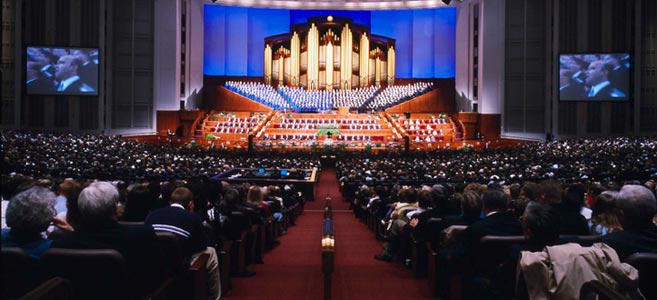
The LDS Church (of which I am a member) is hosting its semi-annual world wide General Conference this weekend.  The conference is broadcast from Salt Lake City, UT to 13 million members of the church around the globe.  The conference mostly includes talks given by the leaders of the church given in the Conference Center, a building designed and built primarily for this one purpose:

With 21,200 seats, the Conference Center is considered to be the largest theater auditorium in the world; the next nearest holds only about half as many people. But the months of careful planning and preparation create an unmistakable atmosphere of a house of worship as more than 100,000 Saints gather in the Conference Center twice a year to hear the counsel of living prophets and sing the hymns of Zion.
Last week the Church released a news brief describing some of details that take place in preparation of the conference:
An extraordinary amount of work requiring the coordination of many Church departments and hundreds of people around the world goes into preparing for general conference. The five sessions of conference draw a total of about 100,000 people to the Conference Center every six months and are broadcast to millions more around the world. 

The article provides some details about the building of the rostrum, the floral arrangements, the camera, sound, lighting, satellite broadcasting, translation, teleprompting and others aspects that happen behind the scenes to make the conference successful.  But success from the perspective of the "behind-the-scene" design is defined in an interesting way:
“Our goal is to be totally transparent,” said Russ Crabb, a producer for general conference. “We want to come away from conference with a message that’s clean and clear to everyone who’s listening or watching, and we want to support the First Presidency and Church leaders at a level that does that.”
“I think the overall level of preparation lends itself to the importance of conference,” said Thomas Smith, safety manager for the Church Media Services Department. “There is planning so this experience is not one that detracts from the spirit of conference. . . . We’re trying to make it something that will touch people’s hearts and bring them to Christ.”
The idea of transparency of service design is not a new one, it's what makes the backstage preparation difficult;  if transparency in the preparation fails the delivery of the core service is compromised or at least sub-optimal.


Check out the videos on the link about the preparation that goes in to producing a weekend of spiritual enrichment. 


March 16, 2011

Sound as an element in experience design

Another quick post since I am spending most of my time writing my dissertation. I thought this was a good example of using sound as an element of service design.

Making the queue part of the experience: Disney Edition

I'm in the thick of dissertation mode, but I found this video interesting and wanted to post it just to be able to record it.

March 2, 2011

Dinner and a Movie - Mash-ups

Service Encounter Onstage recently blogged about the benefits of combining two experiences into one - a dinner AND a movie. AMC calls is "Fork and Screen".


I think the premise is solid; however, I think it is folly to think that since I do movies well, I can easily do food well or vice versa.  Certainly the nature of the experience is different, the first being the tangibility of the food vs the intangibility of the movie - if the food is no good the blame falls on the theater, if the show is no good the blame will fall on the movie producer.  Ordering and eating food is an active customer action while watching a movie is passive.  I wonder if combining these two disparate forms of experience is a good idea from a management stand point; at the very least it would raise a lot of questions about how quality and experience theme be maintained, how are customer expectations managed, how do HR policies change etc?

Something like this came up in class the other day as a joke.  We were discussion the intangibility of services and compared a massage to an auto repair shop. Massages are very intangible because you leave with only a feeling of relaxation, but no physical product.  I always thought that an auto repair was pretty tangible because you do get a car back when you are finished, but a student pointed out that because it is difficult for customers to know if the car is actually fixed or if it needed what was said to be fixed, it was very intangible and customers leave feeling stressed.  So we came up with a recommendation of a massage at the auto repair shop to relive stress of the unknown.

All this talk of combining things reminded me of a term "Mash-up" made popular by the television show Glee.  the idea of a mashup is to combine elements of two songs to create a new better song - maybe the melody of one song with the lyrics a rhythm of another  In their words:
"A 'Mash-up' is when you take two songs and you mash them together to create an even richer Explosion of Musical Expression."
It seems to work best if the two songs have something in common enough for the audience to pickup on the clever combination of the themes of the two songs.  Perhaps similiar advice might apply when considering combining two experiences.  Maybe a dinner and a movie might fit better together than a massage and an auto repair?


Here's a clip of some Glee mash-up action.  Enjoy!

March 1, 2011

Analytics of a Service

The good news is that I have recently accepted a faculty position at the Naval Postgraduate School in Monterey California!  I will likely be teaching business statistics, so in preparation I have started an additional blog to record some idea to share with my future student along the line of business statistics.  In the meantime, I'll keep posting here too.  In honor of this new blog, I found a great clip from IBM touting the use of analytics in a healthcare setting:

  We had a great discussion in my operations management MBA class yesterday about what I identify as 2 main frameworks that can be applied to practical service operations management.  I call them analytical and behavioral.  Under analytical we discussed queuing, revenue management, optimization, simulation, data modeling, etc, while under the behavioral framework we have to understand motivation, experiences, emotions, needs, etc.  Because customers are often in the service process, ignoring the behavioral aspect can be detrimental.  Additionally, behavioral aspects of a service cannot be delegated to the marketing department alone, instead the discussion of the experience desired for customers has to be a part of the operations management priorities or it won't be executed.   This clip discusses how a hospital in Toronto has been able to record and analyze data from a new born from the instruments that surround it. The difficulty in the behavioral side of service operations management is that measurement is hard and near impossible in real time.  While it is fairly easy to count how many people are in a line at a give time, it is not easy to tell who is upset about it and who is not.  

February 14, 2011

Enchanted Art of Disney Cruise

I've blogged about this before here, but I like the idea so much I wanted to show it again - now it full production mode.  What I like most is that it is more than just a new monitor with an animation on it, if it ended there it would just be a TV with a motion sensor on it.  The exciting part is the interaction that can take place in the game.

February 4, 2011

Back of the house management: Airport baggage handling edition

Not a lot of detail about how they do things (i.e., this is a commercial of sorts for IBM services), still this video does a fair job of describing the complexity of baggage handing and routing. My wife and I had a conversation about this on our last flight; we were both in awe that baggage usually (not always...) ends up where we are going even after hoping several airports with delays and cancellations.


My favorite lines:

... there are two worlds, the worlds that the customer goes in and the world of the processes, like baggage handling.

... we must make more capacity available by making the system smarter.


At first blush it seems that this type of operational efficiency improvement has little to do with the "experience" of a customer since the customer is not directly being processed. However, we all know that after a long day of flying the worst thing that an airline could do is say that your bag is in the Bahamas (unless you are in the Bahamas - in which case good for you...) Worst still, is that this type of service failure becomes apparent to the customer at the END of the experience. My research suggests that that is the worse possible time for such a low point in the experience. So, its easy to see that although this is clearly not a customer facing operation, it has dramatic impact on the overall experience of flying.


Further thoughts: it might be interesting to consider if the timing of when to tell a customer that their bag is not going to be at their final destination upon arrival will have impact on service recovery aspects. Again, research suggests that if you have bad news for a customer, you should give it to them early on as opposed to later. Similarly, steps could be taken to facilitate the service recovery before landing perhaps expediting the final stages of the flying experience further enriching the recovery efforts. I would imagine that the capability to do this exists in most modern airlines, but little along these lines are attempted.

January 17, 2011

More on Queuing: Disney World Edition

I recently had a discussion with my wife while waiting in a long queue at a wedding reception about queue management. One thing I found out is that I have been saying "balking" wrong (pronounced "bawking" like a chicken - no 'l'). We discussed ways that the bride and groom could have managed the line different to make the time pass a bit better, like more pictures and stories to see about the bride and groom, maybe a sign saying "expect 10 minutes from here", fast pass given to special guests, etc.


Here was an interesting New York Times article I stumbled on with some things that Disney does (hat tip Design For Service).  It is good article about taking queue management to an extreme and is worth a read.  Here are some excerpts:

In one corner, employees watch flat-screen televisions that depict various attractions in green, yellow and red outlines, with the colors representing wait-time gradations.
If Pirates of the Caribbean, the ride that sends people on a spirited voyage through the Spanish Main, suddenly blinks from green to yellow, the center might respond by alerting managers to launch more boats.
Another option involves dispatching Captain Jack Sparrow or Goofy or one of their pals to the queue to entertain people as they wait.
The following sounds like revenue or demand management applied to queuing:
What if Fantasyland is swamped with people but adjacent Tomorrowland has plenty of elbow room? The operations center can route a miniparade called “Move it! Shake it! Celebrate It!” into the less-populated pocket to siphon guests in that direction.
 Behind-the-scenes systems — typically kept top secret by the company as it strives to create an environment where things happen as if by magic — are also highly computerized. Ride capacity is determined in part by analyzing hotel reservations, flight bookings and historic attendance data. Satellites provide minute-by-minute weather analysis.

January 16, 2011

Queuing theory explained well

A bit delayed, but I thought this was a good video explaining some principles of queuing:

November 12, 2010

More thoughts on operational capabilities vs. experience design

From marketing guru Seth Godin's blog post today:

It used to be that if you wanted to build an organization, you had to be prepared to do a lot of manufacturing and assembly--of something. ...

Restaurants used to be built by chefs. Now, more than ever, they're built by impresarios who know how to tie together real estate, promotion, service and chefs into a package that consumers want to buy. The difficult part isn't installing the stove, the difficult (and scarce) part is telling a story.

I'm talking about intentionally building a structure and a strategy and a position, not focusing your energy on the mechanics, because mechanics alone are insufficient. Just as you can't build a class A office building with nothing but a skilled carpenter, you can't build a business for the ages that merely puts widgets into boxes.
 Mr. Godin's thoughts are expressed in a different way, but I think the message is similar to a post I had yesterday.  Let's start to flush this idea out a bit more by creating a classic 2 by two matrix with experience design capabilities on one axis (low to high) and operational capabilities on the other.  Something like this:


So now what?   Well, I imagine the the high/high quadrant is a good place to be, but it implies high costs, but also high quality and value - think Disney. The low/low quadrant on the other hand is low service and low value, low costs - think vending machines.  It is interesting to think about the possibilities of the the other two quadrants.  For high operational capabilities, but low experience think traditional fast food with factory like precision, but very little emotional experience.   This quadrant has probably been well tread and is what most traditional operations management  people consider when thinking about improving a service.  Low operational capabilities but high experience design may lead to a service full of emotional stimulus, but with the risk of service failure lurking around since there is no operational backbone to support the experience. 

Still working through this idea and wondering if it is of any value when considering service strategy?  I think we could find examples of service firms trying to shift their offering into a different quadrant, for example McDonald's with a major redesign of store and Starbuck's pulling on the reins of their baristas operational efficiency .


I'm interested in hearing what you think about the idea.

November 11, 2010

Learning Service Management through Sesame Street: Accommodation Strategy

I'm still a pretty slow learner and Sesame Street is at about the right level for me:


I watched this video with my son tonight and it reminded me of the HBR article titled "Breaking the Trade-Off Between Efficiency and Service" by Francis Frei.  Professor Frei brings up the librarians problem, mainly that sometimes customers might want something that is not usually offered (um num num..cookies...)  and service providers have to make a choice to accommodate or not.  She argues that services that choose to accommodate special requests have higher levels of perceived service experience, but also have higher costs.  She encourages service providers to think about different types of customer induced variance when trying to create an accommodation strategy.

The library, for example, is a pretty low accommodation service, but how could it maintain its low cost while adding a degree of accommodation?  One way would be to create a self-service option that could provide some cookies in the library (vending machine).  Another way would be to outsource some cookie production to another service provider that has the capabilities of producing cookies at a low cost.  Finally, the library could maintain its "books only" policy by, as Frie puts it,  "limiting the service breadth." I read that as meaning create a service process for which customers will not ask for special accommodation.  In the case of the library maybe these means switch completely to e-books - if Cookie Monster still wants a cookie, send him am electronic tracking cookie...

This post was brought to you by the letters C and A and the number 4.